
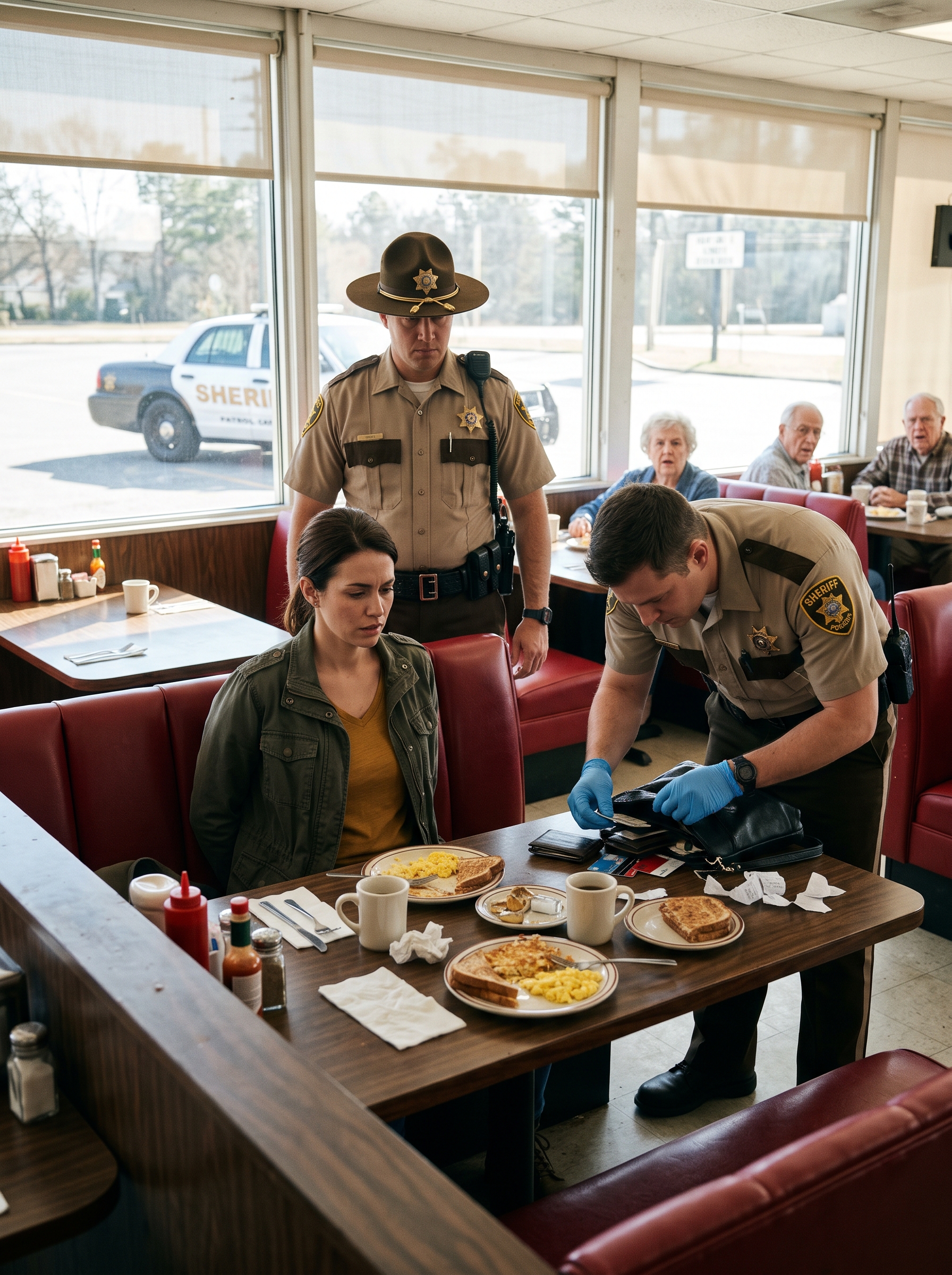
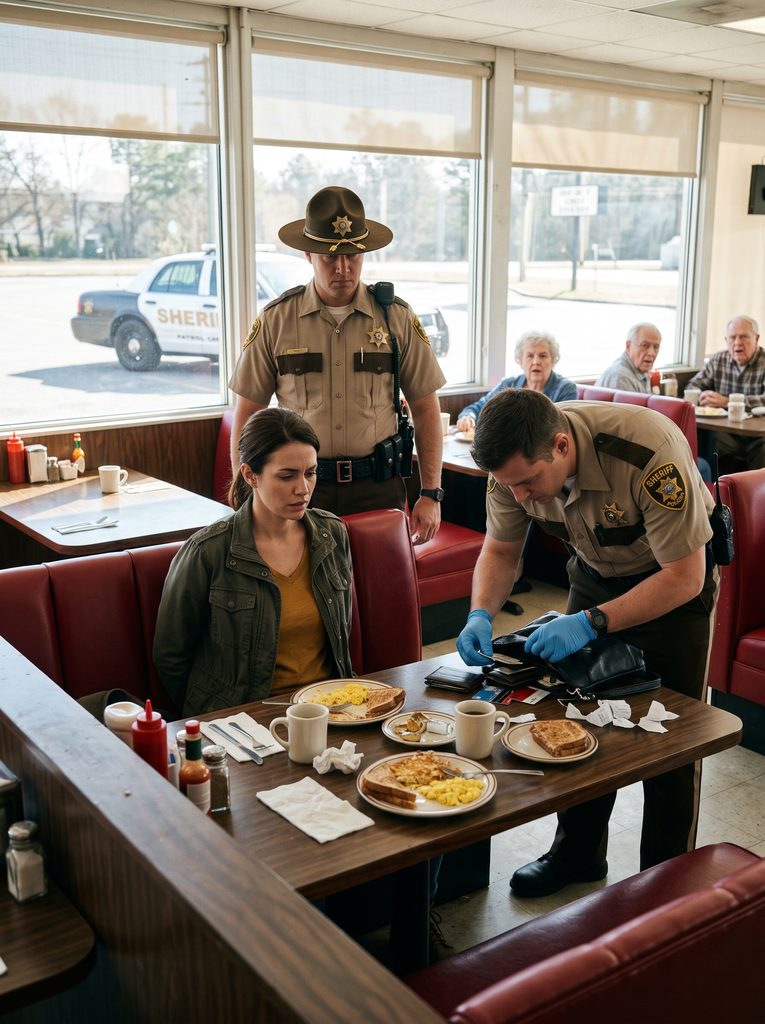
“Hands behind your back, right now!” Sheriff Dalton Voss’s voice boomed through the Magnolia Diner, rattling the windowpanes.
Every fork dropped. Conversations died mid-sentence. Customers froze in terror as the broad-shouldered, thick-necked sheriff slammed my shoulder down against the red vinyl booth.
I didn’t flinch. I didn’t cry out. With steel digging into my skin, I kept my composure, slowly swallowed my mouthful of fried catfish, and breathed.
My name is Amara Whitlock. I am forty-four years old, born and raised in Georgia, and for six years I have served as a United States District Judge. But dressed in a denim jacket with my hair braided, all Voss saw was a Black woman he presumed was isolated, powerless, and defenseless.
He had no idea my federal credentials were inside my handbag. Nor did he know why I was really in Pell County, or that thirty-one handwritten letters from terrified local residents had been locked inside my Atlanta chambers for months.
“You’re making a serious mistake, Sheriff,” I warned him evenly.
“I don’t make mistakes in my county, lady.” Leaning down, reeking of stale coffee and cigar smoke, he yanked my right arm behind my back and ratcheted the second cuff tight. “You match the description of an armed robbery suspect. And right now, you’re resisting arrest.”
I hadn’t moved an inch or raised my voice. Yet he hauled me out of the booth with brutal force, violently shaking the table. My water glass tipped over, splashing ice and water across the floor. An elderly patron halfway rose to intervene, caught Voss’s venomous glare, and sank back into his seat. For twelve years in Pell County, no one had dared cross Dalton Voss.
Leaning into my ear, Voss whispered with cruel satisfaction: “You think you’re smart? Around here, nobody hears you scream. And nobody is coming to save you.”
He dragged me through the glass doors toward his idling squad car. A young deputy followed behind, awkwardly clutching my purse. Inside it, my encrypted government phone began vibrating insistently with high-priority alerts from Chief Judge Harold Brennan.
Voss thought he had intimidated just another helpless traveler. He couldn’t begin to imagine who he had really put in cuffs—or that his reign was about to implode at the station.
Federal judges do not roam small rural towns looking for confrontations. Our duty is to rule from the bench, not run sting operations. But Pell County was personal.
My maternal aunt, Lorraine Bishop—seventy-six and retired after thirty-four years teaching elementary school—lived near Halvorsen Springs. For months, she had sent me newspaper clippings about disturbing local arrests: a mechanic jailed for “loitering” beside his own shop, a church deacon hit with “obstruction” for questioning why his son was being searched, and elderly widows losing their family farms to sudden tax foreclosures.
In June, Aunt Lorraine sent something bigger: a manila envelope filled with thirty-one desperate letters from local citizens detailing extortion and intimidation by Sheriff Voss. Because I had no investigative authority as a judge, I brought the letters directly to Chief Judge Harold Brennan, who referred them to the FBI’s Public Corruption Squad and the U.S. Attorney’s Office. To protect the integrity of the case, I pledged to recuse myself from any future proceedings.
Three weeks ago, Aunt Lorraine fractured her hip. I took leave to care for her. That afternoon, I stepped out to pick up her prescriptions at Pruitt’s Pharmacy and stopped by the diner for lunch. Twenty-two minutes later, Voss arrested me.
The ride to the station took six minutes. Voss drove with one hand, humming along to country music and shooting smug smiles at me in the rearview mirror. The young deputy in the front passenger seat, whose name tag read Miller, held my purse nervously, repeatedly glancing back with deep unease.
“Run her name when we get in,” Voss ordered. “She was probably scoping out the pharmacy for pills. I know her type.”
Inside the squat brick station, Voss dragged me across the floor. “Put her in the booking chair. I’ll be in my office.” He strutted in, kicked his boots up on his desk, and shut the glass door.
At the booking desk, my phone buzzed again inside my purse. Deputy Caleb Miller hesitated, then unzipped the bag to catalog its contents and locate my ID. He pulled out my wallet, followed by the black leather credential case tucked right behind it.
His fingers froze.
Beneath the light, the gold eagle seal gleamed above the inscription: United States District Court, Northern District of Georgia — The Honorable Amara J. Whitlock, United States District Judge.
Miller turned bone-white.
“Judge Amara Whitlock?” he whispered, his voice trembling across the silent room. “United States District Court?”
The desk clerk took off her glasses. Another deputy pushed back from his desk as if it had burst into flames.
“Sheriff!” Miller’s voice cracked. “Sir, you need to come out here right now!”
Voss stormed out, scowling, ready to berate the room. But when he saw the gold badge in Miller’s shaking hand, the swagger evaporated from his shoulders.
“That’s impossible,” Voss stammered, snatching the leather case and examining it under the fluorescent lights, desperately hunting for signs of a forgery.
Before he could speak, my phone screen lit up on the counter. Deputy Miller read the preview from Chief Judge Brennan’s secure line:
“Amara, where are you? Call immediately. The FBI advised that the Pell County public corruption raid is moving today. Agents are on the ground in Halvorsen Springs. Confirm you are safe and away from the sheriff’s office.”
Miller looked like he had seen a ghost.
I looked Voss dead in the eye. “Sheriff, you said nobody was coming to save me.”
Distant sirens began wailing down the highway, growing louder by the second.
“You were right about one thing,” I said softly. “Someone is coming. But they aren’t coming for me.”
Panic seized the station. Voss fumbled for words, his arrogance melting into a desperate grimace. “Judge Whitlock… this must be a misunderstanding. Maybe we can resolve this privately in my office?”
“You threw me in cuffs without probable cause, fabricated a charge of resisting, and threatened me,” I replied, my calm voice echoing off the walls. “And now that you know who I am, you want to handle it behind closed doors? Deputy Miller, take these handcuffs off me.”
Miller hurriedly unlocked them. Both of my wrists were swollen and ringed with deep crimson lacerations; my left wrist was fractured where Voss had twisted it against the diner booth.
The heavy front doors burst open.
Three federal agents in FBI vests swept inside, flanked by Assistant U.S. Attorney Monica Delgado and Lead Special Agent Thomas Greer. Voss stepped forward, extending a hand to play the genial host, but Lead Agent Renee Calloway brushed past him without a word and came straight to my side.
“Judge Whitlock,” Agent Calloway said, noticing my injured wrists with a clenched jaw. “Are you all right?”
“Preserve every piece of evidence,” I answered. “The diner’s security tape, the booking log, and every body camera.”
AUSA Delgado held up a federal search warrant signed by a U.S. Magistrate Judge in Macon, authorizing the immediate seizure of all computers, financial books, and arrest records dating back eight years.
As Voss tried to protest, Deputy Miller stepped forward holding a battered, blue spiral notebook with bent corners—the kind bought for a dollar and twenty-five cents at Dollar General.
“There’s something else you need to see,” Miller said, his hands shaking. “I wrote down every illegal arrest the sheriff ordered.”
For fourteen months, Miller had secretly logged the truth: cash extorted during routine traffic stops, bogus charges filed against innocent citizens, and forged police reports. The most chilling entry came from the previous August: eighty-one-year-old Hattie Greene. Voss had arrested her on fabricated disorderly charges after she refused to sell her prime land to Pinecrest Holdings—a shell company secretly operated by Voss’s brother-in-law. When she repeatedly begged for her heart medication in her holding cell, Voss told the deputies, “She’ll live.”
She died within forty-eight hours, and her property was seized and auctioned off at a fraudulent tax sale.
Federal agents confiscated forty-two boxes of records, eleven computers, and $43,600 in bundled cash hidden behind Voss’s desk. That afternoon, the Governor signed an emergency order suspending Voss, and Agent Calloway unpinned the badge from his uniform.
True federal justice doesn’t hurry like television; it builds an airtight case. A year later, Dalton Voss stood trial before a federal jury in Macon, facing sixty-three pages of civil rights violations, conspiracy, wire fraud, and obstruction.
On the stand, Voss’s defense attorney challenged me: “Judge Whitlock, couldn’t you have stopped your entire arrest in five seconds simply by announcing your title?”
I looked straight at the jury and answered: “Yes, I could have. But the Constitution doesn’t exist just to protect federal judges. It exists to protect waitresses, church deacons, elderly men with walking canes, and widows who need their heart medication. If the only shield against a corrupt sheriff was a badge in my purse, then nobody in Pell County was truly safe.”
The jury convicted Voss on every major count, and the federal judge sentenced him to seventeen years in prison. His co-conspirators were imprisoned, and nine stolen parcels of land—including Hattie Greene’s forty-two acres—were returned to their rightful families.
When Pell County settled my civil lawsuit for $425,000, I gave every cent away. I funded a college scholarship in Hattie Greene’s memory, donated to rural land defense, and built a free legal clinic inside the fellowship hall of Mount Zion Church.
The community named the clinic The Notebook, honoring the dollar-twenty-five journal kept by Caleb Miller, who stayed on to ensure honest records under a newly appointed reform sheriff.
Dalton Voss believed no one in his town would hear an innocent person cry out. But it took one judge sitting quietly in a diner booth, thirty-one desperate letters, and a young deputy with the courage to write down the truth to prove that the law was listening after all.