
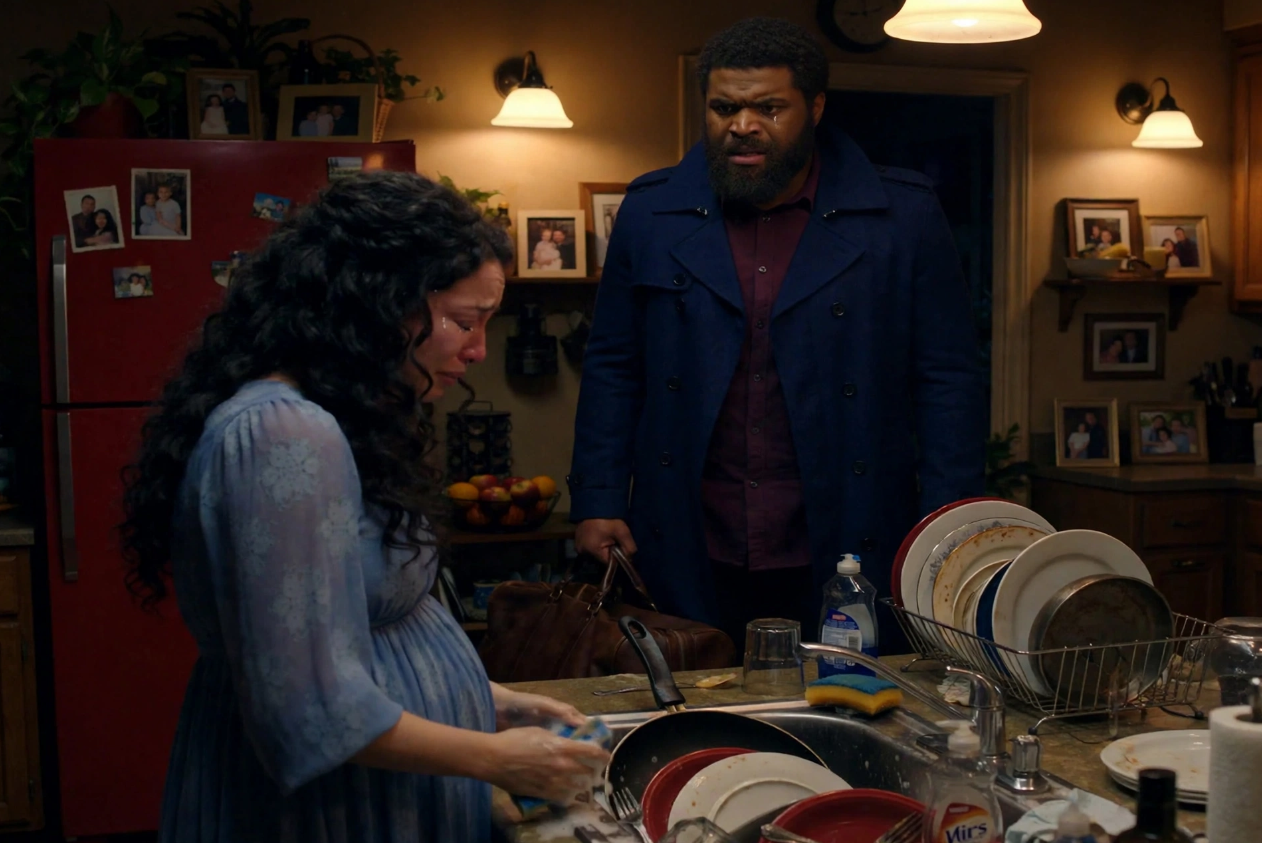
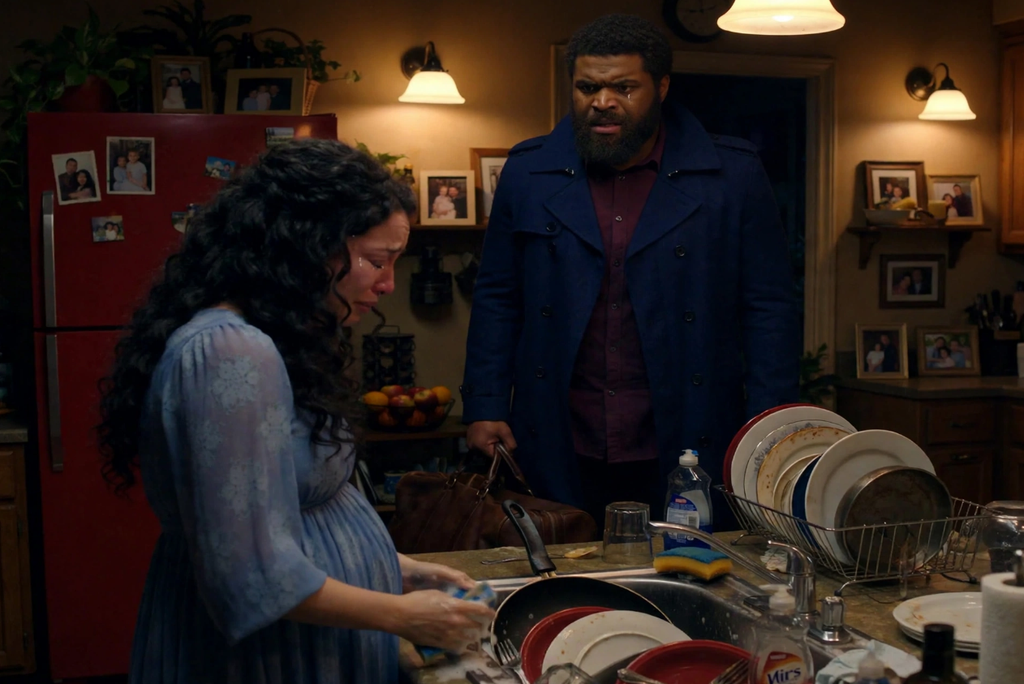
“She is seven months pregnant — and you sat here while she did everything alone?”
For a moment, nobody in the living room moved.
My mother-in-law, Helen, lowered her takeout box slowly onto the coffee table, as if Marcus had interrupted a perfectly normal evening. His sister Grace wiped her mouth with a napkin. Megan reached for the remote and turned the television off, and suddenly the only sound in the house was the water still dripping from the kitchen tap.
I stayed in the doorway, one hand under my belly, because I did not trust my legs to hold me if I stepped any further.
“Marcus, don’t be dramatic,” Helen said, in that calm voice she always used when she wanted to make me look unreasonable before I had even opened my mouth. “Sofia never asked for help.”
Marcus looked at her. “She should not have to ask.”
“She likes things done her own way,” Grace said quickly. “You know how she is. If we touch anything in her kitchen, she complains it’s in the wrong place.”
“That is not true,” I whispered.
Every face in the room turned toward me, and I wished immediately that I had stayed silent. That was what the last six weeks had taught me: it was easier to wash the plates, fold their laundry, and cook their dinners than it was to be called ungrateful in my own home.
Six weeks.
That was how long they had been living with us. A pipe had burst in Helen’s house at the end of August, and Marcus — who was about to start travelling for work — had begged me to agree to it for one reason only.
“They’ll be there to help you, Sofia,” he had said, kneeling in front of me with his hands resting gently on my stomach. “Mum will cook. The girls will clean. You heard what the doctor said. You need to rest.”
My doctor had said exactly that. My ankles were swelling, my blood pressure had to be watched, and I was supposed to be sitting down with my feet up — not standing at a sink at nine o’clock at night, crying over other people’s dishes because there was not a single clean plate left in the house.
“Marcus,” Helen said, and now her voice softened, the way it always did when she spoke to her son and not to me, “she rested all day. She only went into that kitchen ten minutes before you came through the door. Ask her. Ask her if that isn’t true.”
I felt my face burn.
Because it was the perfect lie. There was just enough cruelty in it to make me sound like a woman who had staged a scene for her husband’s return — and there was nobody in that room who was going to correct her.
Except Marcus was not looking at his mother any more.
He was looking at my hands.
They were shaking so badly that I had pressed them into the sides of my dress to try to hide it. Red, sore, still wet from the sink. And then he saw the washing basket in the corner of the hallway behind me — his mother’s dresses, his sisters’ towels, all washed, folded and stacked by the woman who had been told to rest.
“How long?” he asked me quietly.
“Marcus, don’t,” Helen said.
“How long, Sofia?”
My eyes filled before I could stop them. “Since the second week.”
His jaw tightened. He crossed the room in three steps, took the glass of water Megan had been drinking out of her hand without a word, and brought it to me. Then he guided me — slowly, carefully, as if I were made of glass — to the armchair, the one his sisters had piled their shopping bags on all week.
“Move them,” he told Grace.
She stared at him. “What?”
“Move your bags. My wife is sitting down.”
Grace snatched the bags off the chair as if they had personally offended her, and Marcus helped me sit. The moment I was off my feet, the room seemed to tilt, and I gripped his sleeve.
“Sofia?” His voice changed completely. “Hey. Look at me. Are you dizzy?”
“It passes,” I said. “It passed every other night too.”
He closed his eyes for one second, and when he opened them again, something in our marriage had already changed forever.
“Pack your things,” he said.
Helen laughed — a short, disbelieving sound. “Excuse me?”
“All of you. Tonight. There is a hotel ten minutes from here, and I will pay for it, because I am not a cruel man.” He stood up and faced them, and he was not shouting. My husband has never needed to shout. “But you will not spend one more night under this roof while my pregnant wife cries at a sink and you eat in front of her.”
“You would throw your own mother into the street?” Helen demanded. “For her? She has turned you against your own family in five minutes!”
“No, Mum.” Marcus shook his head. “You did that yourselves. It just took me six weeks to walk through the right door and see it.”
Then Grace said the thing she should never have said.
“Well, where exactly are we supposed to put our things? It’s not as if the spare room is big, and the nursery is the only place with any space left in this—”
She stopped.
Too late.
Because Marcus had turned his head, very slowly, toward the closed door at the end of the hallway.
The nursery.
The little room I had painted pale yellow in June, before they came. The room where I used to sit in the evenings with my hand on my belly, reading the labels on tiny folded clothes.
I had stopped going into that room three weeks ago. It hurt too much.
“Sofia,” Marcus said, and his voice was barely a whisper now. “What is in our baby’s room?”
I could not answer him.
So he walked down the hallway himself, past my washing basket, past my shaking hands, past six weeks of silence — and he opened the door.
He stood there for a very long time without saying a single word.
Then, at last, he spoke, and the whole house seemed to hold its breath.
“Who,” he asked, “took apart my baby’s crib?”