




“Don’t watch the camera.”
Those were the very first words Mia whispered after accusing me of assaulting her.
Not I’m terrified.
Not Somebody call 911.
Not even He put his hands on me.
Just five chilling words, slipping past her trembling lips while my son stood between us with fury burning in his eyes. And somehow, that desperate warning frightened me far more than the strike that had just split my lip open.
My name is Thomas Harrison. I turned seventy that brisk autumn evening, five years a widower, and until that moment, I believed the cruelest fate for an aging parent was simply being forgotten by the family he raised.
I was profoundly wrong.
Sometimes, the people you cherish remember everything about you all too well. They know where you keep your savings, which emotional triggers break your resolve, what guilt weighs on your conscience, and precisely how much humiliation you will quietly swallow before you dare push back.
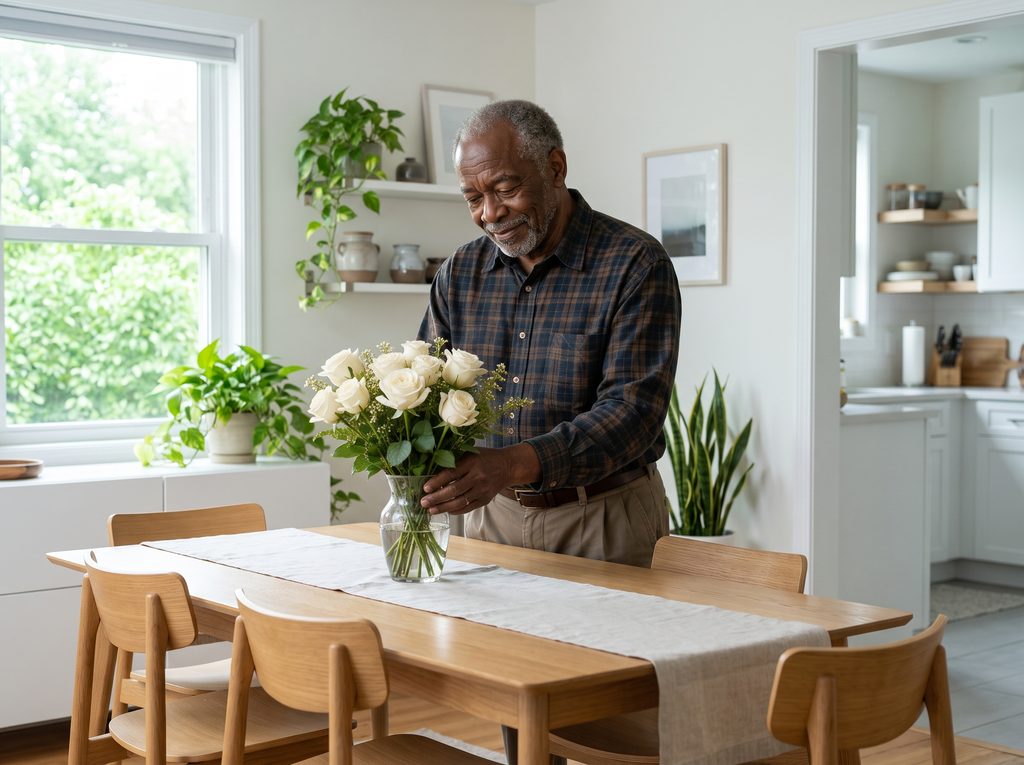
The night had begun with white roses arranged at the center of the table—Margaret’s favorite. Half a decade after cancer took my wife, I still found myself dusting shelves and arranging rooms as if seeking her gentle approval. Thirty years of shared life lingered in every corner of that house: the faint gouges on the baseboards from Daniel’s toy cars, the scuff by the kitchen frame from Claire’s childhood bicycle, and the faded pencil lines inside the pantry charting the kids’ heights summer after summer. Margaret had forbidden me from painting over any of it. “Those aren’t flaws, Thomas,” she’d say with a smile. “They’re the marks proving we were here.”
After her passing, the silence in the empty rooms became deafening. To cope, I clung fiercely to one tradition: hosting a grand family dinner every autumn.
I spent three days roasting Margaret’s signature beef, polishing her silverware, and getting everything ready. When Daniel arrived with Mia, followed shortly by Claire and the grandchildren, the house finally felt warm again. My grandson Ethan dashed through the door waving a taped-up paper airplane, his sister Lily joked about family fashion, and for a few fleeting hours, the crushing weight of aging and isolation lifted from my chest.
Mia sat beside my son, poised and pristine in a cream blouse and gold earrings. She possessed a rare talent for disguising subtle cruelty beneath polished manners. When she first married into the family eight years ago, I welcomed her without hesitation. I paid for their wedding reception, helped fund the down payment on their first home, and covered her father’s extensive medical procedures when their insurance fell short—never once asking to be repaid. I believed family gave freely. Clearly, Mia kept a very different kind of ledger.
Midway through dinner, Claire asked if I could retrieve an old vacation album from the second floor.
I excused myself and took the stairs slowly, smiling as the cheerful chatter and clinking glasses echoed below. But the moment I reached the second-floor landing, I heard a bedroom door click shut.
Mia stood framed against the hallway window, gripping her smartphone tightly. She wasn’t gazing out at the yard; she was watching the staircase, waiting.
When she noticed me, a flicker of pure panic flashed across her face before she masked it behind her usual tight smile.
“Mia? Is everything all right?” I paused, keeping my distance.
“Don’t come any closer,” she breathed, her voice tight and unnatural.
“I’m not moving,” I assured her, raising my hands openly.
Her gaze darted toward the ceiling—directly at the small security camera mounted near the hallway smoke detector. I had installed it six months earlier after a string of neighborhood break-ins; it captured the entire staircase and landing whenever motion was detected.
“What’s going on?” I asked gently.
She didn’t answer. She locked eyes with me, calculating the timing. And then, in a terrifying burst of motion, she took hold of the collar of her blouse and yanked violently, scattering buttons across the floorboards. She tore at her own hair, slammed herself back against the wall, and screamed at the top of her lungs:
“HELP ME! GET AWAY FROM ME!”
I stood frozen in shock. “Mia, what on earth are you doing?!”
“DON’T TOUCH ME!” she shrieked again.
Heavy footsteps pounded up the stairs. Daniel burst onto the landing first, Claire right behind him.
My son took in the sight before him: his wife curled against the baseboard, clothes shredded, hair wild, sobbing uncontrollably. Then his eyes shifted to me. He didn’t ask a single question. He didn’t notice that I was standing several feet away with both hands raised in the air.
He stepped directly between us, his voice cold and menacing: “Dad… what did you do to her?”
“Nothing! I only came up to get your mother’s photo album—”
“He cornered me!” Mia wept, clutching Daniel’s arm. “He followed me up here and wouldn’t leave me alone!”
“Daniel, wait, let’s calm down and look at this,” Claire pleaded, trying to step between them. “Look at Dad!”
“Look at her!” Daniel roared back.
Mia buried her face into Daniel’s chest, weeping softly: “He tried to hurt me.”
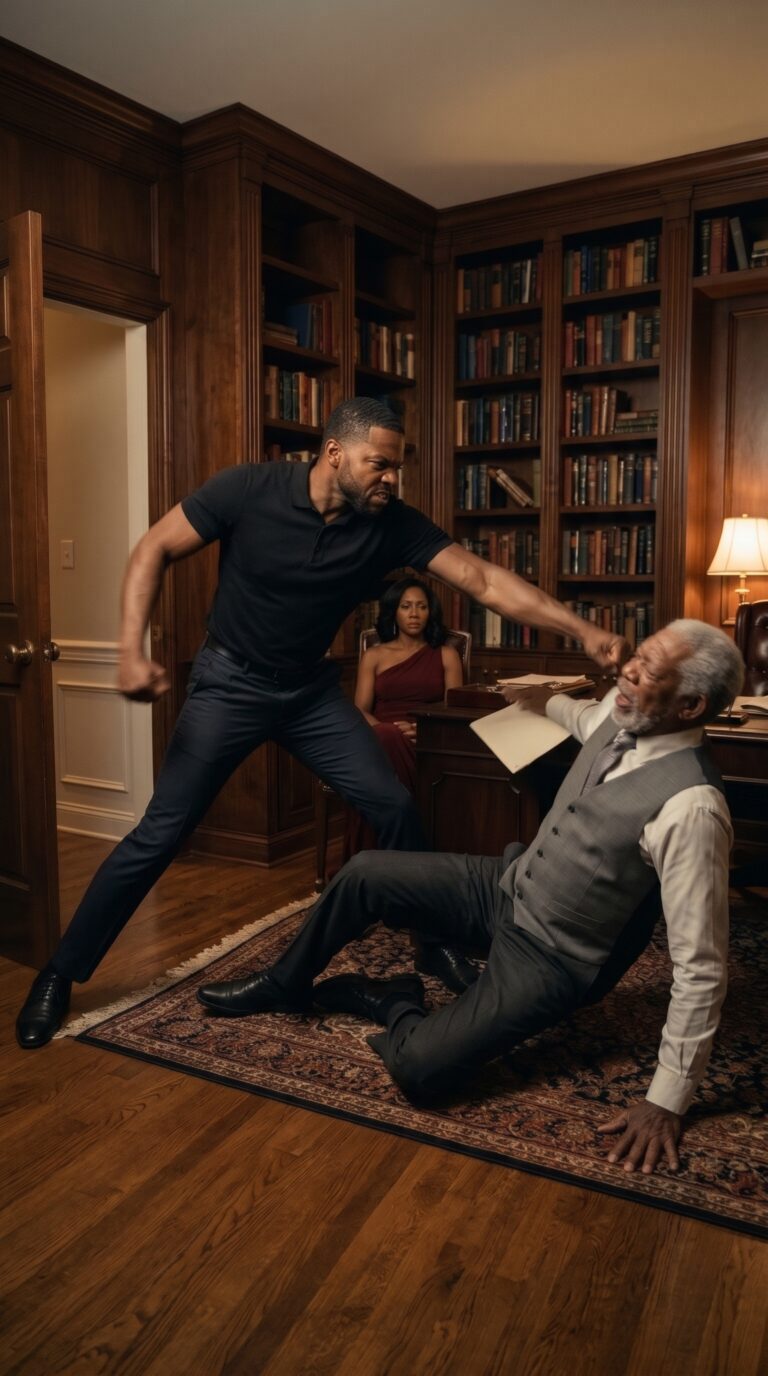
Before the sentence even settled, Daniel’s hand swung forward.
The blow cracked through the narrow hallway like gunfire. My glasses flew crookedly across my nose, and a sharp flare of agony flared across my cheek as I stumbled backward into the banister, tasting copper in my mouth.
This was the boy I had once carried miles through a blizzard to reach a hospital when his fever spiked dangerously high. I had worked double shifts for years to put him through college, and had stood proudly beside him at his wedding. And now, he had struck his seventy-year-old father in his own home without demanding a single shred of truth.
“Daniel…” I managed to whisper, trembling.
“Don’t you dare speak to me like you’re the victim!” he spat, his finger inches from my face. “Get away from her!”
I wiped the blood from my mouth and looked past him, staring directly up at the ceiling.
The tiny red indicator on the lens was blinking steadily.
I raised my arm and pointed toward it. “Daniel, look up. There is a security camera right above your head. It records every movement on this landing. Every single second of what just happened is saved right there.”
Mia’s sobbing stopped instantly. Her entire body stiffened. Her fingers dug violently into Daniel’s arm, and she leaned up to whisper something urgent into his ear.
Daniel’s expression shifted. The righteous anger drained out of his posture, replaced by a sudden, sickening realization.
“Dad,” Daniel said, his voice dropping to a fragile whisper, “don’t touch the system. Don’t touch the logs. Just stand right there.”
He reached into his jacket to pull out his phone to check the live feed.
In sheer desperation, Mia grabbed his wrist with both hands.
“No,” she pleaded under her breath.
Daniel turned to her, confused. “What?”
Mia slowly turned her head, looking straight into my eyes with trembling lips:
“Don’t watch the camera.”
And in that horrifying silence, I realized the trap wasn’t just meant to frame me—the camera had captured something far worse that they never wanted anyone to see.